How can I read my first Korean words?
You practice distinguishing ㅂ, ㅍ and ㅃ, which you hear as English 'p' or 'b', then match sounds to letters to read 불 (fire), 물 (water) and 밥 (rice).
Hear a word, then choose between a flame, grass, and a horn. Your ear can retrain. You will practice hearing three different beginnings, then reading three Korean words.
Listen to the words for flame, grass, and horn. 불 풀 뿔. You hear the same vowel and ending. Find the short downward stroke. Round your lips and keep the vowel steady. After this next model, you repeat. 불.
English does not use this three-way contrast. Both start with closed lips. Listen. 불. Feel the puff from park with your hand. Listen. 풀. Air alone does not identify all three categories. Now repeat slowly. 불.
Close your lips firmly. English does not contrast three categories here, so copy the recording. Listen. 뿔. Keep the puff very small and repeat after this model. 뿔.
Notice where each vowel begins. Listen. 불 풀 뿔. You may hear higher starts in the last two, not an upward slide. After this next model, repeat just the first word. 불.
You have practiced the rounded vowel. Open your mouth and listen to the vowel in this word. 밥. Repeat the whole word after this model. 밥.
Five consonant shapes reflect speech organs. This square shows closed lips. Close your lips and hum, as in English me. Listen. 물. Try repeating it slowly. 물.
Put your tongue tip just behind your upper teeth. Listen. 불 물. Copy the ending without adding another vowel. Now try. 물.
Finish with your lips closed. Don't add another vowel. Keep your lips closed and let no puff out at the end. Try it now. 밥.
A block has a beginning and a vowel; an ending is optional. Look at the picture. Listen to the word. 불. Then try saying it. 불.
Replace the first letter with the square one to mean water. Listen to the word. 물. Now say it after this model. 물.
You've seen both letters. Now practice the ending. Finish with closed lips, without an extra vowel or puff. Read and say the word. 밥.
Listen to the word. 물. Choose the picture that matches. You can pause here.
You can check your choice: the glass of water. Listen to the word, then repeat it after the recording. 물.
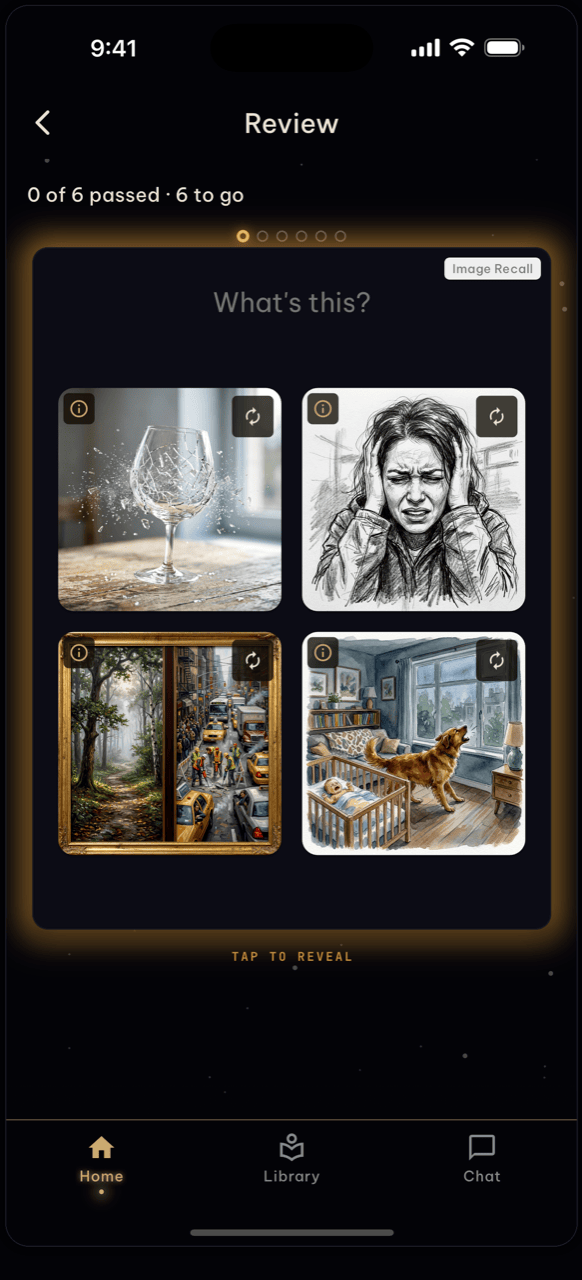
In Synapse, you look at a picture, recall the word, then listen and check. On later days, try recalling each word before you check. Picture the flame and recall its word before you hear the recording. 불.
You practiced three beginnings. You read these three words. 불 물 밥. When you're ready, explore reading blocks without an ending.