Why can't I speak after years of studying a language?
You were taught to translate and keep streaks; instead, train your ear first, learn words without translating, and review before you forget.
You spent years on a language: flashcards, classes, an app streak. Then a native speaker turned to you, and nothing came out. That's not your failure. It's the method's. Let me show you what works instead.
Most language apps are subscription businesses, and a learner who becomes fluent cancels. So they're built for retention, not fluency. And if the results sold themselves, they wouldn't need that much advertising. Two years of daily practice. Here's the report card.
Accent, conversation, comprehension: all failing. Your four-hundred-day streak? A plus. These apps optimize logins, not learning. Some even let you pay to repair a lost streak. That tells you what they're really selling.
So why do people blame themselves? A myth: kids are just better at this. A five-year-old's fluency comes from over 15,000 hours of immersion. You got maybe a hundred, in class: a hundred and fifty times less. No wonder they seem better. A baby spends its first year on sounds alone. Hour for hour, adults learn faster at the start. It's not age; it's method. So what does work? Three principles.
Principle one: your ear has to learn new sounds before new words will stick. Listen. pero. perro. To a Spanish speaker, those are two different words. To many English ears, they sound almost the same. Your ear can't tell apart sounds it never learned, and you can't say a difference you can't hear. In Synapse, you train this with minimal pairs: you hear a word, pick which one it was, and learn to hear the new sound one pair at a time.
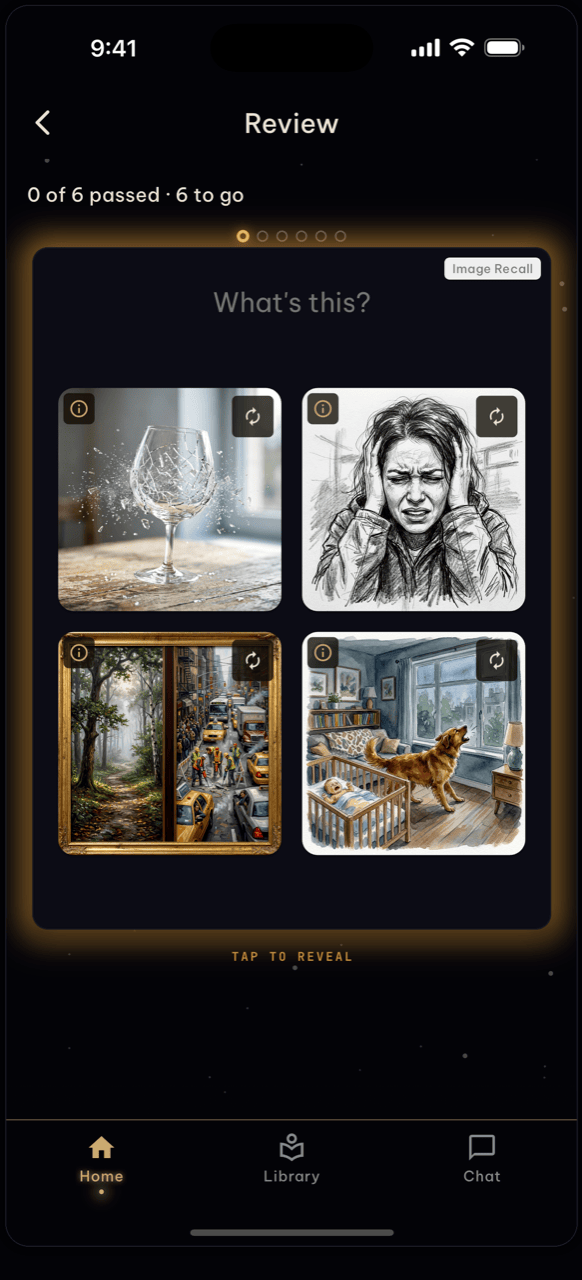
Principle two: never translate. A translation feels like understanding, but it's a crutch. Tie a foreign word to its English translation, and you get one weak link that fades fast. Instead, picture the real thing: an actual dog, not the word for it. Now the word connects to an image, a sound, a feeling. Many strong links, the way native speakers know their words. That's why every Synapse flashcard starts with an image, not a translation.
Principle three: you forget fast. Without review, about half of something new is gone within the hour, and most of it within a day. Your memory is a bucket with a hole in it. The fix is timing. In Synapse, each word comes back just before you'd forget it, and paired with images, those memories become nearly permanent. Pronunciation, no translation, spaced repetition. That's the system.
In Synapse, progress means real proficiency: what you understand, say, and read. Not a streak. And organizations pay for it: tourism boards, companies, missions. They don't pay for engagement. They need people who can communicate, and they'd drop it the day it stopped working. That's proof you can't fake.
Master the sounds first. Skip the translation. Review at the right moment. You're not starting over. You're starting right. The next videos go deep on each principle.