Why does translating in my head make me slow?
Every word takes a round trip through your first language; link each new word straight to a picture or an action instead.
You're in a conversation. Someone speaks. You hear a word. Your brain converts it to English. You understand. Then you build your reply in English and convert it back. By the time you open your mouth, they're already three sentences ahead. You understood everything. You just needed a second. That lag has one cause: you're translating. Fluent speakers don't translate faster. They don't translate at all.
Watch what happens in your head when you translate. A foreign word arrives. Step one: you hear it. Step two: you convert it to English. Step three: you understand the English version. Step four: you build your answer in English. Step five: you convert that answer into the foreign language. Only then do you speak. That's five steps. A native speaker takes none of them. The sound arrives, and the meaning is already there. No conversion, no detour. Sound goes straight to meaning. That one direct link is the whole difference between halting and fluent.
Translating works. You reach the meaning, so it feels like progress. But it caps your speed: you can only follow as fast as you can translate, and conversation won't wait. Kroll and Stewart found that beginners route foreign words through their first language. As fluency grows, that detour drops away. So translating isn't a stage you speed up. It's a scaffold you take down.
There's a second problem, deeper than speed. A translation ties a foreign word to a single English word. One thin thread. But a word you know well sits in a web: a picture, a sound, a feeling, a memory. Native speakers reach their words through that web, never through a translation. Pictures also hold in memory better than words alone. A translation gives you one weak thread, and threads snap. That's why the word you translated yesterday is often gone today.
The fix: link each new word straight to a picture or an action. Never to a translation. Two lines of research point the same way. Stephen Krashen argued that you acquire a language by understanding messages, with your attention on meaning. James Asher had learners act out commands like 'point to the door', with no translation at all. The word bound straight to the action. His learners understood in real time, and they remembered far longer than learners drilled with translations. So when you meet a new word, reach for a picture, an action, the real thing. Never the English word for it.
"Thinking in the language" sounds distant, almost mystical. It isn't. It's the direct link, built enough times that meaning arrives before English can get a word in. You already have it for a few words: a dish you know from a menu, a greeting you picked up on a trip. Nobody gave you a translation, and you understand them instantly. The method is to grow that list. You don't wait to think in the language. You build it, word by word.
You know the rule: picture, not word. But doing that for every new word? Finding a clear image, keeping English off the card, keeping it all organized for review. That's real work. And the moment it gets tedious, you slide back to translations, because typing one takes seconds. The method itself isn't difficult. The logistics are the real challenge.
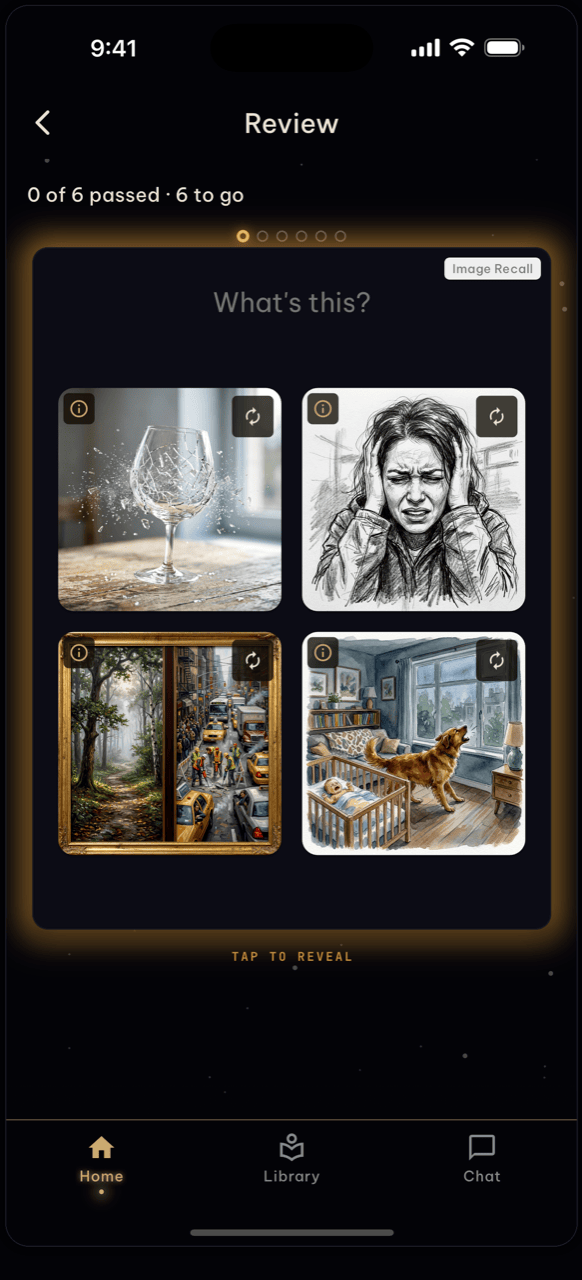
This is why Synapse flashcards start with a picture, not a translation. But some words are hard to picture. What does 'freedom' look like? Most apps send you off to a web image search, to hunt for a stock photo that never fits an abstract idea. In Synapse, you get the image generated for you, by a frontier AI model that can visualize even the most abstract concepts.
Ask for 'freedom', and you get real options in seconds: a bird leaving its cage, an open road, chains breaking apart. Each one captures the idea a different way, in whatever art style you like. Every picture is made to mean the word you're learning, not whatever a search engine happened to find. You pick the one that clicks. On review, you see that image and hear the word, never English text. So each repetition trains the direct link from sound to meaning.
Every review is a rep of the direct link. You see the picture. The meaning arrives. You say the word. There's no translation on the card, so there's no detour. At first, that takes effort. Soon, meaning lands before you try to translate. Rep by rep, the round-trip shrinks, until for that word it's gone. You stop translating; you just understand. Do this across your vocabulary, and the lag from that first conversation keeps closing.
The round-trip makes you slow. Picture, not word, makes you fluent. Next time you meet a new word, catch yourself reaching for the translation, and reach for a picture instead. Open Synapse. Make one image flashcard. Feel the difference on your first review.